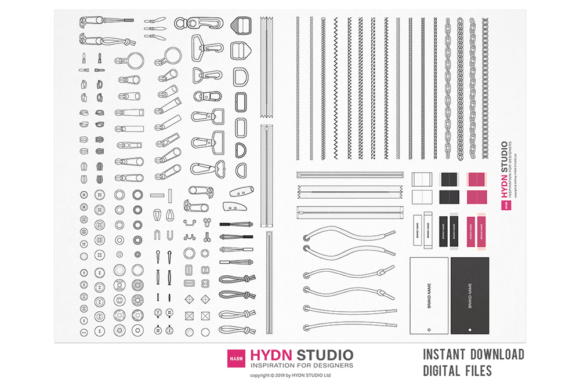
Mastering Vector Garment Accessories Brushes for Professional Fashion Design
In the fast-paced world of fashion design and textile manufacturing, precision is not merely a preference; it is a requirement. Designers, pattern makers, and merchandisers constantly seek tools that bridge the gap between creative vision and technical execution. One such specialized resource gaining traction among industry professionals is Vector Garment Accessories Brushes. These digital assets are designed to streamline the creation of technical flats, mood boards, and presentation decks by providing scalable, high-fidelity representations of zippers, buttons, buckles, and other hardware.
However, integrating these brushes into a workflow requires more than just downloading a file. It demands an understanding of vector graphics, file compatibility, and the specific needs of garment specification sheets. This guide explores the utility of these brushes, compares them with traditional methods, and outlines the critical file formats—AI, EPS, PDF, and high-resolution images—that ensure your designs remain production-ready.
Understanding the Role of Vector Assets in Fashion Tech Packs
Technical packages, or tech packs, serve as the blueprint for garment production. They communicate every detail from stitch type to trim placement. Historically, designers would sketch accessories by hand or use low-resolution raster images copied from supplier catalogs. This approach often led to pixelation when scaled, miscommunication regarding proportions, and increased revision cycles.
Vector Garment Accessories Brushes offer a distinct advantage by utilizing mathematical paths rather than pixels. This means a zipper brush stroke can be expanded from the size of a pinhead to the length of a coat without any loss in clarity. For professionals evaluating resources, the primary benefit is consistency. When every button and snap is drawn from the same library, the visual language of the tech pack remains uniform, reducing ambiguity for factory partners.
Unlike generic clip art, specialized garment brushes are engineered with the nuances of apparel construction in mind. They account for perspective, shading, and mechanical functionality, allowing designers to create realistic representations quickly. This efficiency is crucial when working under tight deadlines, where time spent drawing individual teeth on a zipper is time taken away from structural design decisions.
Evaluating File Formats: AI, EPS, PDF, and Raster Images
To fully leverage vector brushes, one must understand the container in which they reside. The utility of Vector Garment Accessories Brushes is heavily dependent on the file format used for storage and exchange. Each format serves a different purpose in the design ecosystem.
Adobe Illustrator (AI) Files
The AI file is the native format for Adobe Illustrator, the industry-standard software for vector design. When purchasing or downloading brushes, receiving them in AI format ensures maximum editability. Designers can ungroup elements, change anchor points, and modify colors directly. This format is ideal for internal workflows where the design team uses the Adobe Creative Cloud suite. However, its limitation lies in compatibility; non-Adobe users may struggle to open or edit these files without conversion.
Encapsulated PostScript (EPS) Files
EPS is a legacy vector format that boasts broad compatibility across various design applications, including CorelDRAW and older versions of Illustrator. For teams using mixed software environments, EPS files provide a reliable middle ground. They preserve vector data effectively, ensuring that the Vector Garment Accessories Brushes remain scalable. While they lack some of the modern features found in AI files, such as transparency effects in certain contexts, they are robust for printing and basic editing.
Portable Document Format (PDF) Files
PDFs are often overlooked as a source for editable vectors, but they are highly effective for sharing final proofs. A PDF containing vector brushes allows stakeholders to view the assets without needing specialized design software. While not ideal for creating new brush libraries from scratch, PDFs are excellent for archiving and referencing standard accessory dimensions. They ensure that the visual integrity of the accessories is maintained across different operating systems and devices.
High-Resolution Image Files
Despite the superiority of vectors for technical drawings, high-resolution raster images (such as PNG or TIFF) still have a place. They are essential for mood boards, lookbooks, and marketing materials where photorealism is preferred over schematic clarity. When comparing Vector Garment Accessories Brushes to raster images, the trade-off is clear: vectors offer scalability and small file sizes, while high-res images offer texture and lighting realism. A comprehensive design toolkit often includes both, using vectors for specs and images for presentation.
Comparing Vector Brushes to Alternative Methods
When deciding whether to invest in a library of Vector Garment Accessories Brushes, it is helpful to compare them against alternative approaches commonly used in the industry.
- Hand-Drawing: Traditional sketching offers unparalleled artistic freedom and uniqueness. However, it is time-consuming and difficult to replicate exactly across multiple pages of a tech pack. Vector brushes provide speed and uniformity but may feel restrictive to designers who prefer organic, loose lines.
- Photographic Cutouts: Using photos of actual hardware provides realistic texture. Yet, these images are difficult to recolor digitally to match fabric swatches. Vectors allow for instant color changes, enabling designers to visualize how a gold buckle looks compared to silver without reshooting photos.
- Generic Shape Tools: Basic software shapes can mimic simple buttons or circles, but they lack the detailed mechanics of complex closures like invisible zippers or toggle cords. Specialized brushes fill this gap by providing pre-built complexity.
The decision often comes down to the stage of the design process. Early conceptualization may benefit from the freedom of hand-drawing or generic shapes, while the technical specification phase demands the precision of vector brushes.
Best-Fit Situations and Limitations
Vector Garment Accessories Brushes are not a one-size-fits-all solution. They excel in environments where accuracy, repeatability, and scalability are prioritized. They are particularly valuable for:
- Large Collections: When designing dozens of styles, consistent accessory representation saves hours of repetitive work.
- Remote Collaboration: Vector files are lightweight and easy to share, ensuring that off-site manufacturers receive clear, unambiguous instructions.
- Brand Standardization: Companies can customize brush libraries to include their proprietary hardware, ensuring brand consistency across all product lines.
However, there are limitations. Vector graphics can sometimes appear too "clean" or sterile, lacking the tactile quality of real materials. For luxury brands where the feel of the leather or the sheen of the metal is central to the appeal, vectors may need to be supplemented with high-resolution textures or photographs. Additionally, users must possess a moderate level of technical skill in vector software to manipulate and customize the brushes effectively.
Making an Informed Decision
Choosing the right digital resources involves assessing your current workflow and future goals. If your team struggles with inconsistent tech packs or spends excessive time redrawing standard components, integrating Vector Garment Accessories Brushes could significantly enhance productivity. Consider starting with a small set of essential items—such as standard zippers and common button types—to test compatibility with your existing software.
Ensure that the provider offers files in multiple formats, particularly AI and EPS, to guarantee flexibility. Check if the brushes are organized logically, allowing for quick retrieval during intense design sprints. Finally, evaluate the level of detail provided; overly complex vectors may slow down computer performance, while overly simple ones may fail to convey necessary construction details.
By balancing the efficiency of vector tools with the realism of high-resolution images, designers can create comprehensive, professional-grade documentation that bridges the gap between creativity and manufacturing. The right digital assets do not replace design skill; they amplify it, allowing professionals to focus on innovation rather than repetition.