The Power of Play: How Group Drawing Activities Foster Creativity and Friendship in Children
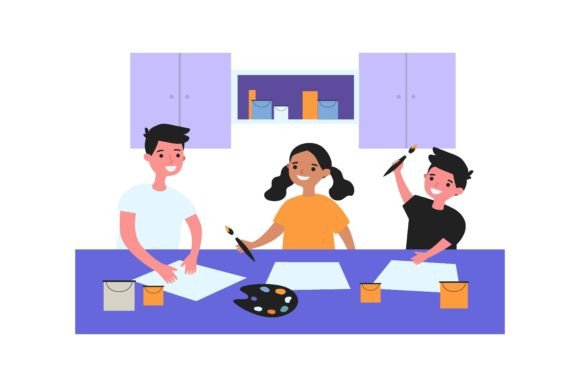
In the bustling landscape of modern childhood, where digital screens often dominate leisure time, the simple act of picking up a brush or crayon holds profound significance. A cartoon group of children drawing together is more than just a charming visual; it represents a foundational educational and social experience. This flat vector illustration style, often depicting kids having fun with colourings, pieces of paper, and brushes, encapsulates essential concepts of art, hobby, creative work, and friendship. But beyond the aesthetic appeal, what is actually happening when children gather to create art collectively?
Understanding the dynamics of collaborative artistic expression helps parents, educators, and caregivers appreciate its value. It is not merely about keeping children occupied; it is a complex interplay of cognitive development, emotional regulation, and social skill-building. This article explores the multifaceted benefits of group drawing activities, explaining why this traditional hobby remains critically relevant in today’s fast-paced world.
More Than Just Scribbles: The Cognitive Benefits of Collaborative Art
When we observe a group of children engaged in drawing, we might see chaos or simple play. However, from an educational perspective, this is a high-level cognitive exercise. Art is a language that allows children to express thoughts and feelings they may not yet have the vocabulary to articulate. When done in a group setting, this process is amplified.
Creative work in a social context requires children to negotiate space, share resources, and interpret each other’s ideas. For instance, if two children are working on a single large piece of paper, they must communicate to ensure their drawings complement rather than clash with one another. This fosters spatial awareness and problem-solving skills. They learn to plan ahead, consider the perspectives of others, and adapt their creative vision in real-time.
Enhancing Fine Motor Skills and Coordination
On a physical level, using brushes, crayons, and markers helps develop fine motor skills. The precision required to stay within lines or mix colors strengthens the small muscles in the hands and fingers. This is crucial for later academic tasks such as writing. In a group setting, the variety of tools available—perhaps one child uses thick charcoal while another uses fine-tip pens—exposes participants to different tactile experiences, further enhancing their sensory integration.
The Social Fabric: Building Friendship Through Shared Creativity
The concept of friendship is central to the image of children drawing together. Art acts as a social lubricant, breaking down barriers and providing a neutral ground for interaction. For shy or introverted children, joining a drawing group can be less intimidating than entering a competitive sport or a loud game. The focus is on the activity, which reduces social pressure while still encouraging connection.
- Shared Goals: Working on a mural or a collective storybook gives children a shared purpose, fostering teamwork.
- Empathy Development: Seeing how peers interpret the same prompt differently teaches children that there are multiple valid perspectives.
- Conflict Resolution: Disagreements over color choices or space usage provide low-stakes opportunities to practice negotiation and compromise.
These interactions lay the groundwork for healthy social relationships later in life. The bonds formed over shared creative struggles and triumphs are often deep and lasting. As children laugh over a spilled paint pot or admire each other’s unique styles, they build a sense of community and belonging.
Integrating Art into Modern Education and Daily Life
In contemporary education, there is a growing recognition of the importance of STEAM (Science, Technology, Engineering, Arts, and Mathematics). The "A" in STEAM is not an afterthought; it is the bridge that connects technical skills with human creativity. Group drawing activities are a practical way to integrate arts into daily routines, whether at school, in after-school programs, or at home.
For parents, facilitating these sessions does not require expensive equipment or professional training. The essence lies in the environment. Creating a dedicated "creative corner" with accessible supplies encourages spontaneous artistic expression. Inviting neighbors or classmates over for a "draw-and-chat" afternoon can transform a regular playdate into a meaningful developmental experience.
Overcoming Common Misconceptions
There are several misunderstandings about children’s art that can hinder its potential. One common assumption is that talent is innate and that only "gifted" children benefit from serious art engagement. This is false. The benefit of drawing lies in the process, not the product. Whether the result resembles a masterpiece or a abstract scribble, the cognitive and social gains are identical.
Another misconception is that group art leads to distraction. While it can be noisy, this "productive noise" is often a sign of active engagement and collaboration. Instead of silencing children, adults should guide the energy towards constructive interaction. For example, suggesting a theme like "underwater world" or "future city" can channel individual creativity into a cohesive group project.
Practical Tips for Facilitating Group Drawing Sessions
To maximize the benefits of collaborative art, consider the following strategies:
- Provide Variety: Offer diverse materials such as watercolors, pastels, markers, and collage items. Different mediums encourage different types of thinking and interaction.
- Set Clear Boundaries: Define the workspace clearly. Use large sheets of paper taped to tables or walls to give everyone ample room while maintaining a shared canvas.
- Encourage Dialogue: Ask open-ended questions like, "Tell me about your character," or "How did you choose that color?" This promotes verbal expression alongside visual creation.
- Focus on Effort, Not Outcome: Praise the process—"I love how you mixed those colors"—rather than the final image. This builds resilience and a growth mindset.
- Model Collaboration: Adults can participate by drawing alongside children, demonstrating how to share tools and offer positive feedback.
These steps help create a safe and stimulating environment where children feel free to experiment. The goal is to make art a habitual part of their lives, akin to reading or playing outside.
The Long-Term Impact of Early Creative Habits
The habits formed in childhood often persist into adulthood. Children who regularly engage in creative hobbies develop a tolerance for ambiguity and a comfort with experimentation. These traits are highly valued in the modern workforce, where innovation and adaptability are key. Furthermore, the ability to collaborate effectively, learned through group drawing, translates directly to professional teamwork.
Beyond career implications, art serves as a lifelong tool for mental well-being. It provides a healthy outlet for stress and emotions. By establishing a positive relationship with creativity early on, children equip themselves with a coping mechanism that can serve them throughout their lives. The joy found in a simple act of drawing with friends can evolve into a sophisticated appreciation for culture, design, and self-expression.
Conclusion: Embracing the Colorful World of Collaborative Creativity
The image of a cartoon group of children drawing together is a powerful symbol of holistic development. It reminds us that art is not a solitary pursuit reserved for the elite, but a communal activity that nurtures the mind, heart, and spirit. By understanding the depth behind this simple hobby, we can better support the children in our lives.
Whether in a classroom, a community center, or a living room, providing opportunities for collaborative art is an investment in the future. It fosters friendship, enhances cognitive abilities, and cultivates a lifelong love for creative work. So, gather some paper, distribute the brushes, and let the children create. The results may surprise you, not just in the artwork produced, but in the connections formed and the minds expanded.
In a world that increasingly values efficiency and standardization, the messy, vibrant, and unpredictable nature of children’s group drawing is a refreshing reminder of the human capacity for imagination and connection. Let us champion these moments of creative togetherness, for they are the building blocks of a more empathetic and innovative society.